Feed

2013-04-30

Mad Men Of The World – 50 years of Jahrbuch der Werbung

"And concerning the girls 
– all of us wanted to be a little Don Draper."
Behind the scenes of the 50th anniversary of the Jahrbuch der Werbung – and of Willi Schalk's life as a true Mad Man.


Willi Schalk
Potsdamer Platz – Good morning everyone. I welcome you to the infamous day after. It's the day after the awards ceremony of the German Jahr der Werbung (JdW). The JdW is one of the most important award shows in the German advertising business. But more to that later. For me, this day after starts with a discreet hangover. Definitely, I had too many Mojitos and too much of this strong Irish whiskey that I unfortunately can't remember the name of. Nevertheless, the day after has dawned and I am about to meet Willi Schalk in the very heart of Berlin. Willi and I are meeting at ALEX. It's a cozy mix between a café, a bar and a restaurant. My colloquialist is considered as one of the most distinguished personalities of the German and even the international advertising industry. Meeting Willi Schalk and having a chat about advertising means a tough project management for both of us. Because Willi is still a citizen of the world. On these grounds, I am happy to meet him in the course of commuting between Düsseldorf, New York, Florida, Southern Germany – and finally a journey around the world with his wife.

For those lads who do not know Willi Schalk: shame on you! The famous German magazine Der Spiegel once headlined: "Willi the kid". It's the year 1986 when Willi heads BBDO Worldwide in New York. Straight after the infamous Allen Rosenshine, Willi is the most important guy of BBDO during the late 1980s. At that time, he is responsible for numerous dependances of BBDO all over the world. That's why other media called him "Worldwide Willi". It's a life between the continents. From the US to Germany, from Australia to South Africa, from Japan to wherever. It's a life up in the air. Bonus miles guaranteed.

Willi – born in 1940 – is a selfmade man. Neither an university-entrance diploma nor a real education as an advertiser. Nevertheless, he managed to become one of the most important German ad guys during the 1980s. In 1986, Willi is even counted among the driving forces of the merger between the advertising agency networks DDB, Needham Harper Steers and BBDO to the holding Omnicom. The New York Times compared that deal with the birth of "a new superpower in the advertising industry". And it definitely was. By now, Omnicom is the heaviest juggernaut in the global ad biz: 70.000 employees, a revenue of 13 billion $ and an international network of more than 1.500 agencies worldwide – including BBDO, DDB and TBWA. The starting shot for this historical deal was fired on a boozy sailing trip on the Elbe near Hamburg. It seems to be an unbelievable Mad Men's story for its own: Having some beers and creating the new "superpower" in advertising en passant. Allen Rosenshine once fancied: "Willi has a keen mind, brilliant ideas and an enchanting charm." After hearing all that stuff, we can say that Willi could have a little clue concering advertising.

Jahr der Werbung: Megaphon trophies
Today, nearly 30 years later, it's the day after – the day after the 50th anniversary of the Jahr der Werbung. And the day after the Megaphon Event that has been celebrated at RADIALSYSTEM V in East Berlin. Since 1964, the JdW is published as a hardcover book by the German publishing house Econ illustrating the German year of advertising. Because of its weight I really can't recommend reading it on the toilet. By now, the JdW belongs to the most important awards in the landscape of German advertising. In the meantime, it has become more than only a documentary of an advertising year even though that's still the key demand of it. This year, HEIMAT, Kolle Rebbe, serviceplan and Ogilvy & Mather were the most awarded agencies. HEIMAT was also honoured as Agency Of The Year for the second time in a row – see one of their famous commercials below. And OLIVER VOSS won the title as Newcomer Agency Of The Year. Have a look at all Megaphon winners of 2013. 


Well, the day after is a cold and dismal saturday – a typical February day in Berlin. Willi comes directly from the JdW editors' breakfast at Ritz Carlton which is located just around the corner of the ALEX. He's had a diced bacon and onion omelet. "I am full.", he remarks. After having a small cigar (Dannemann Rozet) and ordering a hot lemonade because of a cold, Willi immediately starts to chitchat. He still seems to be amused by the memory of the get-together of the JdW's new and old editors. Willi belongs to those "old" editors. The JdW has been one of the numerous projects that Willi managed besides his fascinating career in the advertising business and later in the media branch. Together with Helmut Thoma and Peter Strahlendorf, Willi released the JdW for the last 20 years – starting in 1991. The troika has a large share concerning the further development of the JdW. They introduced the title Newcomer Agency Of The Year and the Megaphon awards as well – two essential incredients of the JdW even today. By the way, the first winner of the Megaphon award: a Toyota ad from the year 1993. Legendary ...


I am asking Willi if he feels any kind of nostalgia about the end of an era. "Actually not.", Willi answers in a satisfied way. "But there has been one moment the last night, I had very strange feelings.", he adds. The moment he is referring to was the laudatory speech of Michael Trautmann. Willi tries to explain what he means by these strange feelings: "Holy shit, it sounded like an obituary!" And he continues with an amused smile: "Well, I decided two things yesterday: In my last will, I will declare Michael Trautmann as the writer of my funeral oration. And moreover, I will appoint the unknown art director of Leo Burnett for designing my death notice."

Death notice for Walter Lürzer – created by Leo Burnett
Although Willi is very pleased regarding the new troika – which consists of Anette Scholz, Thomas Rempen and Peter Wippermann – on one affair he has a very critical look: the renaming. After 50 years under the flag of Jahrbuch der Werbung – which means Yearbook Of Advertising – the new editors eliminated the part "Buch" (book) and turned the name into Jahr der Werbung. A book publisher kills the "book". Interesting move. "If I had shifted the name, I would have modified the term 'Werbung' ...", Willi closes this chapter. But besides that, he seems to be perfectly happy with the new troika.

Well, let's take a look back into the year 1964 when the JdW was being introduced by Eckhard Neumann and Wolfgang Sprang. The JdW firstly started under the name: "Werbung in Deutschland – Jahrbuch der deutschen Werbung". It was the first widespread documentary of German ads in retrospect to one complete year. It should illustrate a cross section of German advertising. And that's still the character Willi describes: "The Art Directors Club is responsible for the genuine hotshots. The JdW illustrates the cross section." And he adds, shaking his head: "Unfortunately, we should award the golden lemon as well." Because some agencies seemingly submit worthless junk.

While the JdW was getting started during the 1960s, Willi followed suit. When working in a medium-size industry company as marketing director, a certain Jürgen Scholz – later the founder of Scholz & Friends – asked Willi to join the "other side". "Mr. Scholz, I have no understanding of advertising.", Willi replied politely. "Well, that doesn't matter. We don't understand it as well. We just act as if ...", Scholz countered. This has been the starting point of Willi's career in advertising. While keeping this first exciting years in mind, Willi remembers a very extraordinary party in Düsseldorf. At that time, Düsseldorf was the hotspot of the German advertising branch. It's fair to say that Düsseldorf was the heart of the German Mad Men during the late 1960s. Frankfurt was the second pulsating city for ad guys. Hamburg was in it's infancy. And Berlin didn't really exist at that time. Well, back to Düsseldorf. The year is 1968 or 1969, however it's the heyday of the hippie movement. The famous advertising agency Special Team – later known as Team/BBDO – is having a party in an underground parking garage in the middle of Düsseldorf. Suddenly, two policemen arrive in front of the building. Willi leaves the underground garage and tries to explain the events: "Well, gentlemen … I know: it might be a little too loud … But we are an advertising agency. There is just a handful young folks celebrating …" One of the policemen replies: "Well, could we have a look inside?" After climbing down the stairs and entering the underground garage, they aren't able to see their hands in front of their faces. A sweetish smell is in the air. And on the walls … a selection of self-made porn movies is running.
What the fuck?! Self-made porn movies?! I interrupt Willi's anecdote in total disbelief. And he explains with the following words: "These self-made porn movies … Well, it was kind of a swap meet – especially between BBDO and DDB. It simply was kind of a competition." And he summarises with a chuckle: "Well, the young avant-garde carried on the sexual revolution more quickly and more consequently. And the advertising business was of course a central part of it."
But back to the story: The two policemen guide Willi in front of the building and one of them instructs him: "Do the following: close the garage door and turn the music down. Concerning the rest, the neighbours hopefully won't notice it. And I don't want to give you further instructions regarding these other things ..." What a cooperation!
That's definitely a Mad Men's story through and through. And compared to the original Mad Men from Madison Avenue in New York, Willi notes: "During the 1960s and 1970s, the differences between advertising agencies in New York and Düsseldorf weren't that huge." And he continues: "At our place, the woman affairs played a more important role than in New York. Perhaps, the Americans boozed more than we did. But when it came to how pick up the girls … All of us wanted to be a little Don Draper." And if anybody knows it, it's certainly Willi Schalk. Because he experienced both sides of the Atlantic Ocean.

Willi Schalk while talking to Michael Conrad
Today, Willi recalls the past and philosophises about the bygone years as well as the status quo of advertising. "Basically, the shifts in advertising have been not that dramatic as the general shifts in the society. During the 1950s and 1960s, it was absolutely unthinkable that you hire an homosexual. And women needed an approval written by their men for going to work. Compared to those socialpolitical changes, advertising remains almost the same." Nevertheless, Willi is of the mind that a lot of details of course have changed. And what's about the social influence of advertising? "Well, there are many critics who believe that advertising is able to start trends. Don't fret! In this regard, advertising is harmless.", Willi says. And respecting trends in the ad biz he especially observes a change of meaning between network agencies and independent agencies. "In Germany, the Lufthansa case is symptomatic. It illustrates that shift." Since the end of 2011, the German advertising agency Kolle Rebbe drives the Lufthansa's business forward – globally! Therefor, Kolle Rebbe is supported by The Network One. It can be seen as an expression of a paradigm change.
And what's about the development of German advertising against the background of 50 years of JdW? Willi resumes that Germany was considered to be globally one of the most creative ad scenes – especially relating to create adverts during the 1960s and 1970s. But by introducing the commercial television, the Germans lost a lot of their international rank. "In the early days, German commercials were ordinary filmed adverts." Willi judges the German advertising branch of today to be leading nowhere – but still it's mixing it at the top everywhere.

Finally, in answer to the question why he now – at the age of 73 – ends his role as one of the JdW's editors Willi replies casually: "Basically and philosophically, everything in life has a good reason and a real reason ..." And Willi grins.

Oh, by the way: the day after of course had a night before … And that night was quite entertaining. See for yourself ...


Yours sincerely,
William James Carlton


PS: Some book advices by Willi Schalk:

By Phil Dusenberry


By Vilim Vasata


By Allen Rosenshine


2013-01-31

Mad Men Of The World – an obituary

"Timmi was one who polarized – somebody with a mind of his own. Smart, generous and visionary."
Behind the scenes of five exciting decades in the international advertising business 
– an obituary for Hans-Joachim Timm.

  
Casino Kampnagel, Hamburg.
Barmbeker Strasse – A warm welcome to Hamburg. Warm? No Chance. It's cold. It's cloudy. It's windy. And snow covers the roofs of the city's skyline. During my last trip to Hamburg, the weather conditions were, let's say, more pleasant. But that's another matter. However, what does actually lead my way to Hamburg? Well, I am meeting Manfred Schneider to have a talk about Hans-Joachim Timm – a genuine archetype of a Mad Man. Regrettably, Hans-Joachim Timm surprisingly died in October 2012 at the age of 70 – questionless much too early. Manfred and I are meeting at Casino Kampnagel – it's a nice restaurant and café belonging to Germany's largest production and performance facility for national and international freelance artists. It is one of the most reputable venue for the performing arts. The Casino Kampnagel is located straight around the corner of Manfred's office. You just have to cross the street. Today, Manfred runs his own small agency focused on lifestyle communication. Manfred and "Timmi" were colleagues. But they were more than just colleagues. They were companions. And finally, they were friends. Manfred is a true advertising guy too. He worked for renowned agencies such as BBDO, Ogilvy & Mather and TBWA on the creative side of life: as a copywriter and later as Creative Director. And in collaboration with Timmi, Manfred was co-founder of HEADS' Communication which advanced to an absolute hot shop in the German advertising industry during the 1980s. Finally, it was at BBDO in the late 1970s, when their ways crossed for the first time. Accompanied by Manfred, I will once more run the Mad Men's timemachine and travel through five exciting decades in the advertiser's life of Hans-Joachim Timm. It would be a pleasure to welcome you on board. So please check in.

Hans-Joachim Timm, Manfred Schneider and Manfred Vogelsänger.
Now then, who was Hans-Joachim Timm? Well, Hans-Joachim Timm – his friends called him "Timmi" – was one of those original Mad Men. And more than that. Timmi really was one of the rare Mad Men of the world: he was a globetrotter and a cosmopolitan. Eventually, he worked in Hamburg, Duesseldorf, Stockholm, New York City, Barcelona, Frankfurt and Zurich. Timmi's employers were doubtfully of distinction. He worked for advertising agencies such as William Wilkens, McCann Erickson, Ted Bates, BBDO, Leo Burnett, Publicis, Saatchi & Saatchi and TBWA. During his career, Timmi won more than 50 international prices including the treasured Cannes Lions. And in the 1980s, Timmi was responsible for introducing the famous ADC Nails as one of the most well-respected awards in the German creative industries. It was even Timmi who built the prototype of the Nails. But first things first.


1960s – Joining the Mad Men's family
It must have been the mid of the swinging 1960s: the people were watching Winnetou, James Bond or Edgar Wallace. And almost everybody was listening to the songs of the Beatles, the Rolling Stones or Bob Dylan. Ludwig Erhard was running West Germany and the German economic miracle was in full swing. While the women's skirts were becoming shorter day by day, Timmi did his first professional steps after finishing his studies at Kunstschule Alsterdamm in Hamburg. His first position: the publishing house Axel Springer. Timmi promoted subscriptions of the daily newspaper Die Welt. But that wasn't challenging enough for him – not anywhere near. And it doesn't really sound thrilling. That's why he rapidly changed the branch and joined the advertising agency William Wilkens. Founded in 1876, William Wilkens is considered as one of the first advertising agencies of the world. Today it is known as Draftfcb. Chartering William Wilkens meant Timmi's entrance in the advertsing business. And it can be seen as a real enrichment for a whole sector. Thank God. His first clients included British Petroleum (BP) and Johnnie Walker. Delicious. All in all, Timmi was a young guy in the mid of his twenties joining the exciting advertising world globally inspired and influenced by the Madison Avenue of New York City. From that time onwards, Timmi was part of those infamous Mad Men. He actually joined the Mad Men's family.


1970s – Time for globetrotting: Stockholm, New York and Barcelona
Timmi must have been a guy driven by openess and curiosity. Because he absolutely wanted to go abroad. The first destination on his wishlist: Milan. But it turned out quite differently. Timmi joined McCann Erickson and they sent him to Sweden. After four years of living in Stockholm, Timmi joined an eight month Management-Training at McCann Erickson in New York – cheeck by jowl with the original Madison Avenue. That followed, Timmi switched to McCann in Barcelona and was responsible for the creative output of the Spanish settlement during the early 1970s. An extremely sensational campaign during those years were the so called Colors of Liberty. It was a campaign created for the nail polish company Ponds. A couple of years ago, Timmi called this campaign his "entreé into the small Madison Avenue of Barcelona". Finally, the campaign was stopped by the church. Obviously it was too provocative.
Although Timmi travelled around the world, he eventually regards BBDO as his "job-related home". And there at BBDO, Timmi and Manfred met for the first time. I am asking Manfred about his first impression of Timmi. "Well, most people thought that Timmi would be arrogant.", Manfred remembers. And he continues in a nostalgic undertone while smiling: "Because of his manner of walking." But to explain the appeal of being arrogant more seriously, Manfred declares: "As the most advertising guys are, Timmi was cocksure of himself. Anyhow, some people are dubious about themselves but not Timmi. He was one who polarized – somebody with a mind of his own. He always knew where to go. That was admirable. That was great." And Manfred finishes the characterization of Timmi with the words: "Smart, generous and visionary."


1980s – The golden years
After working for Leo Burnett and Publicis during the late 1970s and early 1980s, Timmi turned his back on the big advertising networks. That was a bold step. In the middle of his life, he wanted to be more independent. And so he became. Although they never worked in the same team at BBDO and the job-related ways separated for almost ten years, in 1985 Manfred and Timmi founded HEADS' Communication which rapidly advanced to an absolute hot shop in the German advertising industry during the following years. Amongst others, HEADS' Communication worked for Ellen Betrix and IKEA and were ranked within the top five agencies in various creative ranking lists. The first work of HEADS' was the so called Gummsky Conspiracy. It was a cinema spot for Candy & Company. And it instantly won a Silver Lion at Cannes as well as an ADC Nail and a Clio Award. HEADS' created the spot in cooperation with the famous German producer and director "Bulle" Berndt – a lad who won over 380 numerous international awards and who was highly formative for the development of the advertising film business in Germany. Well, the spot is really oldschool. And it's pretty cool. A must-see!


"Timmi always thought more bigly, more widely and more overhelmingly.", describes Manfred the visionary mind of his friend. And that's why an ordinary office was absolutely out of the question. It had to be something special ... something great ... something unique. And so it became. During that time, the airport of Frankfurt on the Main had been remodeled. And the huge departure lounge was out of use. And what does an available departure lounge and a visionary advertiser mean? Right. An advertising agency residing on 1.000 square meter – including its own shuttle service. Crazy. But how do you furnish such a large office? Well, driven by passion, Timmi did the whole interior design for the office. One day, a painter should color the steel lockers in a specific shade of green and blue. Everybody was happy with the result – except Timmi. In the end, the painter had to color the lockers three times in a row. Well, one item that was certainly one of the office's highlights: a huge glass dome with a white ground that was installed in the middle of the departure lounge. It should be the home of the art directors. The bureau of HEADS' must have been the craziest agency in Germany during the 1980s.
The famous ADC Nails
At that time, Timmi also suggested to introduce the ADC Nails as the annual award of the German Art Directors Club. He is alleged to have said: "Therewith, they can nail their framed certificates onto the wall." The ADC guys obviously loved the idea. Up to the present day, the ADC Germany awards the creative folks with these ADC Nails. The Nails advanced to a real trademark. But that is not the only story which has been told and re-told inside the German Mad Men's society. One story that is still circulating in the branch is the lifesafing of Othmar "Otti" Severin who was president of the ADC Germany during the first half of the 1980s. Otti and Timmi were lodged in the same hotel while visiting the international advertising festival in Cannes. In the dead of night, Otti gave a phonecall to Timmi to tell him that he is really unwell. Manfred narrates that the first thought going through Timmi's mind must have been: "Sure thing, Otti drank too much. Well it's Cannes." Nevertheless, Timmi entered Otti's room, called the reception and asked for a doctor. Thank God. Because it was a heavy heart attack. Otti survived it. Other than that there must exist some more gossip about the Mad Man Timmi … All in all, the 1980s under the flag of HEADS' were doubtfully the golden years in the advertising career of Timmi. This era consisted of self-realization, independency and success.


1990s – Shock and re-start
As mentioned above, Ellen Betrix and Ikea are counted among the clients of HEADS'. And the account of Ellen Betrix was the heavy weight on the clients roster of the agency. In 1992, the brand was bought by Procter & Gamble. "Over night, Procter & Gamble cut us off.", Manfred remembers – still in disbelief. And that meant losing a million dollar baby over night. Because the agency's fee was a seven-digit amount. Game over. "It was like a punch in the pit of my stomach.", Timmi described the sudden end of his baby HEADS' Communication in an interview a few years ago. And he continued: "At first I had to lick my wounds." It was an absolute shock. Well then? "Actually, I hate repeats.", Timmi once told. Unfortunately, he indeed took part in a repeat and chartered again a big tankship in advertising. It was Saatchi & Saatchi in Frankfurt. Obviously, he was unhappy with this situation and started his second try to work autonomously. And the second try was called TIMM'S Communication. During that time, Timmi incredibly managed the creative output of the brand Hohes C almost on his own. Today, a whole department would be necessary to work on an account like that.
While listening excitedly to Manfred and riding through several decades within a few minutes, the ringing of Manfred's cellphone brings us back to the here and now. It's just a short stop in our time journey. When having a look outside, snow starts falling down. You can't miss it because of the huge glass front of the Casino Kampnagel. And what's going on inside? Well, a curry flavor dominates the air because of today's lunch specials. It mixes up with the flavor of our cappuccinos – which meanwhile are empty by the way. And out of the boxes comes the voice of Emilio Santiago ...


2000s – The mountain is calling
Entering the new millennium, Timmi entered a new challenge. The mountains of Switzerland were calling. And Timmi followed. So he joined TBWA in Zurich and worked several years in the position as Chief Creative Officer. That's really astonishing, considering the fact that he was almost 60 years at that time. In the shark tank of advertisers this seems to be an applaudable step. After having his affair with TBWA, he joined a small agency named Guhl/Partners. It was the final part in a big career. During the recent years while working for Guhl/Partners, Timmi shuttled between Zurich and Mallorca because his family was living on the Spanish island. In 2012 he finally decided to move completely to Mallorca …


2010s – Many ideas, endless energy, but too little time
Timmi
Through and through, Timmi was a creative one. Apparently, there was no end of incubating new ideas. And Mallorca should become the place of generating and realising them. One of his lifetime dreams was always to build, design and furnish houses. And that was just one idea to realise. Another one was to create sculptures of steel. And naturally Timmi wanted to continue his work as a feelance art director in advertising. Certainly, that's just an abstract of the package of his ideas. "Timmi was full of vitality. He was bubbling with new ideas. Even at the age of 90, Timmi would have realise them. He was an incredible bundle of energy.", Manfred describes the attitude of Timmi. And he closes: "Maybe he brings in his ideas elsewhere. Maybe we will see him again."

Hans-Joachim Timm surprisingly died in October 2012 at the age of 70 – questionless much too early. The advertising world bows before one of its greatest heads. Dear Timmi, thank you for creating all of these amazing ads. Thank you for thinking out of the box. And thank you for being a humankind who advanced the entire advertising sector. Rest in peace.

Yours sincerely,
William James Carlton

Postscript: 
Hans-Joachim Timm was a Mad Man who really deserves to get posthumously awarded with one of the honorary titles of the German Art Directors Club. Dear ADC, think about it seriously.

2012-12-29

Mad Men Of Riga (3/3)

"Some of these anecdotes are true."
Behind the scenes of !MOOZ.


Janvāra iela – this is where the office of !MOOZ is located. It's the southeastern border of the old town right on the corner of the “legendary“ pub Rock'n'Riga – as far as I know it's actually not legendary. And I think it's currently closed. !MOOZ resides on the third floor. Their bureau offers a fantastic view to the Daugava which is the river that flows in the Baltic Sea.
!MOOZ calls itself a "human agency". The agency is considered to be the only independent agency in Latvia combating against the settlements of the global network agencies such as McCann or DDB. And in doing so !MOOZ is successful – very successful. The agency has been founded by Ēriks Stendzenieks in 1995. During the recent years !MOOZ won more creative awards than any other agency in the Baltics. "It should be somewhere around 100 of them.", Ēriks recounts – including Cannes Lions, Epica Awards, Golden Drums and Golden Hammers. That's certainly a demonstration of their creative strength. And it symbolizes their success. In 2008, !MOOZ was the first Latvian advertising agency being awarded in Cannes. The !MOOZers received a Silver Lion for their campaign "Organ donors". It's a campaign created for the Road Traffic Safety Department (CSDD) to decrease aggressive driving on Latvian roads. Aggressive drivers should look at death from a different perspective.


While waiting for Ēriks I take a look around in their office. Apparently, the guys of !MOOZ love to play darts. And Ēriks seems to be quite good at it. After standing a few minutes in the imaginary waiting line, Ēriks appears. Damn, he seems to be a medley of stressed and bugged out. My first thought: the interview will take 20 minutes at most. But I should be proven wrong. Minute by minute, Ēriks was getting more and more in a chit-chat mood – until we ended up talking for 90 minutes. And I think he had lots of fun while telling all these anecdotes. However, I enjoyed our chat. Hope you too.

Ēriks Stendzenieks, founder and owner of !MOOZ
Ēriks is an astonishing lad. While doing his Bachelor studies in Riga, Ēriks founded his own advertising agency in 1995. At its birth the agency was named ZOOM. I am asking Ēriks for the deeper meaning of the fateful year 1995. As mentioned in the DDB episode, the year 1995 seems to hold a real mystery for Latvian advertising agencies as lots of them were founded in this exact same year. But Ēriks sees it more from the rational perspective of his left brain hemisphere: "I am not a big believer in horoscopes." Ēriks explains this circumstance by using an entertaining metaphor: "It's a kind of a gold rush phenomenon. You see some guys digging gold in Alaska and you say: 'Ah, those guys are there ... oh shit I have to be there too.'" Ēriks tells me that some big brands started to believe that in the former Soviet States there would be the new markets with a big potential. Coca Cola went to the Baltics – and Pepsi followed. Audi went to the Baltics – and Mercedes followed. A lot of global brands did it the same way. And every brand arrived with their ad agency. "Nobody wanted to miss the train.", Ēriks summarizes.
One thing of the 1990s Ēriks is still wondering about today, are the lotteries. It was a time when lotteries were not regulated by law. And that means prizes and promises were not regulated either. It rapidly became a trend to arrange lotteries. Ēriks remembers one lottery created by McCann Erickson for the Latvian beer brand Aldaris. "It must have been the biggest lottery in Latvia", Ēriks adds. And it was not only big but also crazy. For collecting 10 crown caps you had the chance to win a car. Collecting 50 crown caps could mean to win a yacht, 75 crown caps a house and for 100 crown caps you could take the so called Grand Prix: car, yacht and house – all together. And indeed, someone won this Grand Prix. "This guy must have been a heavy beer drinker.", Ēriks notes while shaking his head in disbelief. And I am shaking mine too ...
But Ēriks is not only wondering about other advertising guys. He is also surprised at himself. "We were doing things from which we thought it was advertising. But from today's perspective it wasn't advertising. It was some kind of Monty Python stuff which had nothing to do with real advertising. What the fuck ..."

The early years of !MOOZ in 1995 ... known as ZOOM ...
But what kind of advertising did !MOOZ – under the name of ZOOM – create at the beginning? They started with simple decoration jobs for cars and windows. Nothing spectacular. But these were their first steps in the advertising business. And they were kind of proud of taking part in the game.
At that time there was a marketing trend to arrange exhibitions. And companies did exhibitions. It seemed to be a total hyperbole. "It was like walking in a center of Dubai and calling out: 'Oh shit there is a waterfall! Oh shit there is a peep show with naked girls! Oh shit there is a bear driving a motorbike!'", Ēriks describes this era. Everyone wanted to be the biggest, the coolest and the most modern. But this exhibition business meant the first "more or less considerable money" for !MOOZ. Because they won the budget for creating the Latvian stand at the Expo 1998 in Lisbon. And this money gave Ēriks the chance to go over to London for doing his Master studies in Communications Design at St. Martin's College. For a wonder, Ēriks did his Master studies in London without having a completed Bachelors degree because they kicked him out by reason of his commercial projects with his agency ZOOM.
Coming home to Riga he found the agency in a bad shape: "I don't want to remember those hard times." During the following years the agency rebounded and is now considered as the most awarded agency in the Baltics. One cause for this incredible success story could be the proceeded professionalization. In 2007, Ēriks participated at the Berlin School of Creative Leadership. The school offers a MBA program for creative professionals. "I met so many great guys from the best agencies in the world. You would never meet them even in Cannes. I was sitting next to some guys with 400 Lions or something like that. It was such a brilliant experience.", Ēriks reminisces. And this experience equipped Ēriks with additional skills and seemed to be an inspiration as well.
After chatting for about half an hour it seems to be no wonder that it has been Ēriks who primarily went over to western Europe and established a dependance of !MOOZ located in Berlin. This action is very typical for him and illustrates his entrepreneurial courage. Finally, !MOOZ is the first Baltic advertising agency conquering the "Old Europe". It's exceptionally the other way around. But there is a but within this story: "It didn't develop as I expected it. That we would … like … BOOM … kick open doors in Mercedes or Siemens and having a multi million dollar business.", Ēriks says with an amused smile. And he continues: "The big lesson is: advertising is such a human based business. You have to be present 24/7/365."

But Ēriks is not only founder and owner of !MOOZ. He is initiator and director of the Latvian Art Directors Club (LADC) as well. And Ēriks is considered a well-known advertising veteran in the Latvian society in general. He could be one of those infamous Mad Men of Riga. And as I learned, he is.
At least there exists some gossip about Ēriks. People tell each other that Ēriks is sometimes very rough towards clients. Ēriks responds to those rumours with an impish smile: "Some of these anecdotes are true." And he gives me an insight perspective into the true anecdotes ...

Anecdote 1: Eriks and the red pencil.
One day, some guys from Uzbekistan contacted the Client Service Director of !MOOZ. They asked for creating a Corporate Design for their company. The briefing was short. And the time to realize the project was even shorter. The creative team had only five days to create a name, a logo, the corporate colors and some more stuff. There was one important hint within the briefing: No connection to Uzbekistan because the international reputation wouldn't be that good. Although the briefing was strange and the time short, !MOOZ decided to go for it because the Uzbek guys left a credible mark. After five days of hard work, Ēriks was very proud of the result. He remembers the meeting: "Then one of these guys stood up, took a huge red pencil and started to redesign our logo. And he said: 'I can't see Uzbekistan here.'." Afterwards, the Uzbek guys sent an email to the Client Service Director: "We've never seen such a superficial and unprofessional presentation. Next time, please bring some guy with an education in design and someone who knows how to combine colors." Normally, Ēriks is a relaxed dude "but one phenomenon that absolutely crazes me is unexplainable stupidity ... 'I just don't like it this way' or 'Make it more red' ..." And that's why Ēriks wrote an email to the Uzbek guys giving a little lecture on values and behavior. It was written in his "roughest style".

Anecdote 2: Eriks and the falling portrait.
One day, !MOOZ held a presentation to show their ideas of a campaign for promoting Latvia on CNN. Bertolt Flick, "the king of Air Baltic", was one member of the jury. Ēriks started to introduce the ideas of !MOOZ and the king of Air Baltic was not amused. He criticized the approach of Ēriks. Ēriks tried to stay polite. And for the first five times of Flick's critique he obviously managed to do so. But for the sixth time he packed his laptop, slapped the door of the meeting room and ran away. "His critique was personal, irrelevant and baseless. He obviously had a shitty day.", Ēriks explains his glaring reaction. Through slapping the door of the meeting room the portrait of Bertolt Flick felt down and broke. "It was not the beginning of a war. We discovered that each of us has balls.", Ēriks sums up. In the end, it was the starting point of a three year business relationship between Air Baltic and !MOOZ.

Some stuff for Air Baltic

Anecdote 3: Eriks and the porn-presentation.
It must have been the year 2007. The goverment of Latvia just changed and they did a pitch to shift their advertising for the state-owned Riga Airport. !MOOZ was one player of the game. At the final day of the pitch, Ēriks entered the conference room and found himself standing in front of a "board of authorities including politicians and other clerk." Normally, you should behave politically correct in such a situation – normally … Ēriks' intention was to add "a bit more Rock 'n' Roll to their communication". Because Ēriks generally thinks that "the task of creative agencies is to take the clients as fas as you can – and to act provocative and courageous." Finally, his idea was to show examples of innovative and courageous advertising. One case was the one of London's metro. Another case was the British brand Virgin. A big failure … However, Ēriks clicked on the Virgin-clip during the presentation. "Of course it was not THAT Virgin. It was some other virgin which was basically part of a rude porn.", Ēriks tells and adds: "I had 20 seconds to come up with a story explaining what they had just seen. It was one of the quickest decisions I had to do during my whole career." Indeed Ēriks had a logical explanation and could save the situation. Amazingly, this honest board of authorities only noted: "We think that's a bit too sharp for us." Ēriks tells me that he walked out of the conference room and immediately slid down to the floor. "What a bloody situation.", he closes this anecdote.

In the end of our chat, Eriks philosophizes about creativity, strategy and humanity. Ēriks thinks back to an experiment – it's one of those high explosive top-secret things. Normally, those experiments would have to be managed by professionals – by agents like Mulder and Scully. But Ēriks is courageous. He tried to find out how an idea is born. So he took a voice recorder while having a creative meeting and tried to capture the unborn idea. His demand: "How do we come up with ideas through a brainstorming?". Afterwards he listened to the record. What was going on in the room? "It was full of abrupt phrases. You couldn't rebuild it. You just listened to complete nonsense.", Ēriks tells deeply dissapointed. Because neither Eriks nor me were able to solve this question we switched over to another topic. And it's questionless the best friend of creativity. It's about strategy.

Well, strategy … "Strategy? In some companies the only task of strategists is not to talk to the people. The only task is to kill the competitors." Ēriks tells of a meeting of Pampers … "Imagine the world of Pampers: babies, smiling families, softy clouds, love, peace und harmony." Ēriks becomes more and more ironic while narrating. "I walked into the conference room and there was a big banner on the balcony with huge Helvetica letters on it: 'Kill the Huggies!'" That was the headline of the meeting. No harmony. No peace. No love. It was war – advertising war.
I ask Ēriks about his personal labeling on the !MOOZ website. He calls himself "Creative Strategist". He doesn't really take this too serious and starts joking about the term: "During the next few years, I certainly have to call myself Chief Phygital Strategist." Ēriks stumbled upon the word "strategy". He observes an "over-strategising" in the economy. Ēriks enumerates two cases when the strategy was crap. He thinks of New Coke which he calls one of the biggest strategic failures ever. Ēriks speaks very ironically about a "super duper strategic research". And the second case that comes to Ēriks' mind: the merger of Mercedes and Chrysler a couple of years ago. It's not the first time during our conversation that Ēriks shakes his head in disbelief. "Every cleaning lady would have said while scratching her back: 'Chrysler? Mercedes? What a bullshit – of course not!' ..." Ēriks' simple advice is: "Sometimes it's better to ask your grandfather than strategic consultants."

And what he means by that is that a knowledge of human nature and an empathy towards social changes is often more important than spending millions of bucks in creating heavy strategic screeds with millions of data. That seems to be Ēriks' understanding of thinking and acting in a strategic way. One example that puts several social developments in a nutshell is the campaign for the bank Citadele. The banking crises and a social change forced them to do a rethinking. And they did. In the end, the simple formula has been: "You are = You can." And which group of people would communicate the idea in the best way? !MOOZ decided to integrate the Latvian athletes of the Paralympics as the protagonists of the campaign. "Such social things are bigger than everything else: products, services or brands.", Ēriks sums up.


By talking about social changes, the deeper meaning of advertising and its societal impact Ēriks starts to philosophize about humanity and human behavior in general. In the end Ēriks concludes: "In general, it progresses towards humanity. Because 300 years ago your pig became ill and you therefore blamed your neighbor as being a bad guy practicizing black magic. Afterwards you would have burned him at the market place. And everybody was watching and applauding it – not very cool stuff. By comparing things over centuries all in all the world is getting more and more human."

Wish you all a human year 2013.
Yours sincerely,
William James Carlton


– – –
Upcoming story in January:
Mad Men Of The World – Behind the scenes of five decades in the international advertising business.
Hans-Joachim Timm, deceased in 2012, was one of those original Mad Men. Timm worked, amongst others, for advertising agencies such as McCann, Ted Bates, BBDO, Leo Burnett, Publicis, Saatchi & Saatchi and TBWA. And he invented the Nails for the German Art Directors Club during the 1980s … Stay tuned ...

2012-11-29

Mad Men Of Riga (2/3)

"There was a big gap between the progressive agencies and the historic styled soviet organizations."
Behind the scenes of DDB Riga.


Sweet home of DDB Worldwide Latvia
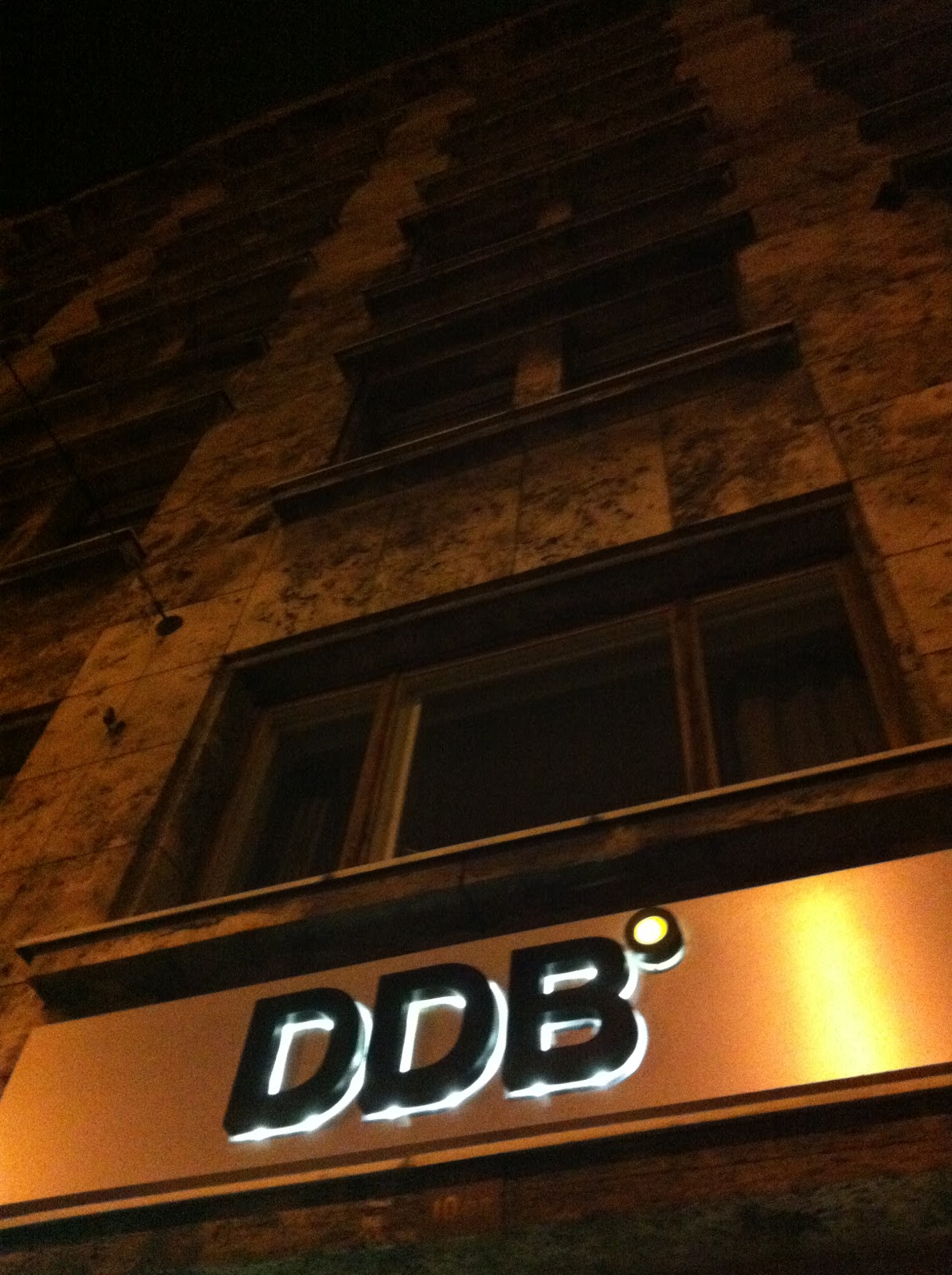
Brīvības iela – the Brīvības Street leads directly to the famous Freedom Monument of Latvia. Right here is where the sweet home of DDB Worldwide Latvia is. DDB is located straight in the beginning of the new town of Riga. The front of the building is built in kind of a rough style. The three letters of DDB inclusive the circle – or does it represent a point?! – flash in the incredible dark darkness of Riga's night life. It looks pretty cool. And you definitively can't miss it.
I am meeting Andris Rubins, Managing Director of DDB Latvia. For more than 12 years he has been part of the DDB family. Previous to our meeting I combed through the world wide web for getting some information about Andris. I figured out that Andris is married, has three children and a troop of labradors. He enjoys playing saxophone and spends most of his vacations in Italy. These high explosive yellow-press-insights you can pick up by reading the introduction of Andris in his role as juryman at the advertising festival Golden Hammer this year. But let's not go deeper in these private details. Moreover I imagined him being an amazingly well-qualified guy to talk about advertising to … And that's what we did: we talked about advertising – surprise, surprise.

Welcome on board of the Mad Men's time machine. Please take your seats. Are your seatbelts fastened? Our upcoming travel destination will be the year 1995. Why 1995? Well, that year seems to be a fateful year for the advertising business in Latvia. If you have a closer look on the trilogy Mad Men Of Riga, it's get obvious: DDB – founded in 1995. McCann – founded in 1995. !MOOZ – founded in 1995. And certainly there is a handful other agencies founded in the exact same year. Does that look like a coincidence? Unlikely ...
And DDB played an important role. In the early stages, it was kind of a mission to support the capitalistic imperialism of McDonald's. The golden "M" sent the DDB troops out to the Baltics to make the world much better by selling fastfood. And the job of the Latvian legion – named DDB – was to adapt international ads for the Latvian market. McDonald's naturally was not the only enterprise conquering the Baltics. It was the starter's gun for many international brands too. By looking retrospectively at the year 1995, Andris was studying at Stockholm School of Economics. Two years later, he started to work as a Marketing Director in the food business. At that time, his mentoring agency was McCann Erickson. Andris describes McCann as the most progressive agency in Latvia during the mid 1990s. But it was not only McCann. Andris was obviously fascinated by the whole branch: "The advertising agencies were the most enthusiastic, progressive, talented and future driven companies.", Andris romanticizes.

Andris Rubins, Managing Director of DDB Latvia with his Mad Men drawing
And by comparing the advertising agencies with the Latvian economy in total Andris quickly recognized an incredible dilemma at that time: "There was a big gap between the progressive agencies and those historic styled soviet organizations." And that's why it has been difficult to do something great at that time. The companies were very scared of doing something wrong. They were totally unskilled: a discouraged gang of freshmen. The consequence: simple ads without any risks. Andris boils it down to a simple formula: "Smiling families." That's his synonym for riskless and boring advertising. But in the early 90s, advertising was not only simple, boring and riskless. Sometimes it was also strange – and sometimes even very strange. In this connection Andris talks about "agressive lotteries" as a popular marketing tool. "Agressive lotteries" – what the fuck?! I couldn't imagine what he exactly meant by that. But a couple of days later I got the answer. This big secret will be revealed in the third part of the trilogy – Eriks from !MOOZ told me absurd stories concerning lotteries in the 90s … Don't miss it …

Back to Andris. I am asking for the first famous ad he noticed. I am expecting some stuff of big players like McDonald's, Coca Cola or something like that. But one of the first ads Andris remembers is a commercial for Grindex, a pharamceutical company in the Baltics. The commercial traces back to a famous Latvian joke. Andris tries to piece the spot together and tells something about two animated birds, a big one and a small one, talking to each other. Regrettably, Andris doesn't get the punch line together. However, it was one of the first very popular ads that has been created in Latvia. The people loved the two birds. Unfortunately, the world wide web doesn't know the spot. Otherwise I would hand the commercial to you on a silver platter … Pardon me. 
Back in the 21st century, Andris seems to be relaxed and happy with the development of the Latvian economy. Up to date, it has been a process of understanding and learning. During the recent years, the whole economy has changed to the better. Today, companies act in a more professional way. They try to be unique with their brands and take risks in their ads. But what's about a change within the society? "Today, people are very critical and very cynical. They don't believe in advertising. They think it's all bullshit.", Andris declares. When having a look back in the early 90s, people at first were very open-minded in Latvia. People accepted brand stories. They believed almost everything. In their point of view, there was no reason for a brand to be dishonest. People were naive in a way. By now, they have understood that brands sometimes hide some facts and overdo others. From Andris' point of view people have learned to be critical, to question ads and to research by using Google. According to that, a lot of things have changed since 1995: the companies, the society and just as well DDB has changed. The DDB troops now consist of about 50 guys – right after McCann the second largest advertising factory in Latvia. By now, DDB Latvia makes the most of its turnover with clients they win on their own. Only three percent of the total income of DDB Latvia is earned by getting network clients. And Andris seems to be very happy about this fact: "… not because somebody calls us from Paris or New York and says: Hey guys, you have two more accounts, please welcome them." In this respect, Andris is sportsmanlike: "It always keeps us very sharp. We have to progress all the time." But what's about the present and the future of advertising? Andris sees the prospective role of advertising agencies in a much deeper sense than simply creating beautiful pictures and showing smiling families. He likewise thinks of consulting, packaging and even product development. Andris thinks more of being a "creative business think tank" than just being an agency doing nice ads. And he is proud of the strategic strength of DDB Latvia. But he also sees a problem in the knowledge and the perception of the clients: "Normally they don't ask for this kind of support. Normally they don't expect advertising agencies to help developing new products." Andris smiles proudfully while telling that his team regularly surprises their clients by showing more facets than being creative in the ordinary sense of an advertising agency.

One case Andris is very proud of is the Ventspils venti campaign. And he can be proud of it. Finally, the campaign won the Grand Prix, the gold medal in the category integrated campaigns and the People's Vote at Adwards Festival in 2012. And it was not only a creative campaign. They created a new product used by thousands of people. Last but not least it was very effective too ... "The whole city loves the idea. People have integrated it in their everyday life.", Andris outlines this success story. And DDB Latvia has some more success stories to tell – e.g. the Alumni donation campaign for SSE Riga, an untypical bank communication for Nordea and some other stuff. The secret recipe for good advertising seems to be very simple: "The more we do unexpected things, the more people will wonder, talk to each other and the brands will become interesting and unique." One example that shows this approach is the gamification case of O!Karte using the world-renowned game Tetris.


OKarte tetris case study from DDB Latvia on Vimeo.

Combined with some other ads and campaigns DDB became the most awarded agency at Adwards 2012 and at Password EFFIE 2012 Competition as well. Not only because of their success at some festivals DDB Latvia is considered as one of the most creative agencies in the Baltics. But what effect does this award balance have? For creative people? "They love it. It's the olympic games of the business." And for the clients? "It's very different. Some think it's bullshit, some are very proud of it and some only believe in Effie awards." After a short pause, Andris tells a crazy story of a bank account he managed a couple of years ago. The Marketing Manager of the bank told Andris, if DDB won the Golden Hammer Award, that would mean the knockout for the agency. The client didn't want to have creative work on its account. Because that would mean the agency doesn't sell their products and services. "What the fuck is this?", Andris is still wondering. And he continues: "That's oldschool-thinking."

Happy DDB people at Password EFFIE Awards 2012
But there are not only fretful moments in the advertising business. One story Andris really rejoices in is the creative battle between the two top mobile brands: O!Karte vs. Zelta Zivtina. But it was not only a fight between two brands. It was a fight between two creative teams as well. Andris describes this creative battle as a "smart way of making fun of the competitor". And he avoids the term "fight". Andris really enjoys telling this story. After gambling a few rounds the general public of Latvia noticed this exchange of blows. Everyone was curious about what would happen next. It became a "real time show". And for the agencies it was a challenge to be smarter than the "enemy". This creative battle is one of those stories that went out of the advertising business. It became a common talk on the streets. By the way, the "enemy" of DDB was !MOOZ – it will be the final part of the Riga-Trilogy. Watch the case here.

Last but not least, there is one open-ended-question: What's about this Mad Men drawing of Andris? Well, three years ago in 2009, Andris celebrated his 10th anniversary at DDB – it was April 1st. The DDB team sent out a press release to all media in Latvia. The news: Andris Rubins becomes the 2nd Latvian guy who will act in the television series Mad Men. And it went further. Andris should figure Bill Bernbach, who is the "B" in DDB. And although it was April 1st, all the media took it quite serious and the news worked a circuit. 
Today, Andris is still amused about this story: "I took part in a client meeting, not knowing anything, and my phone started to ring. Media, friends and relatives – everyone wanted to congratulate me. All I could answer was that somebody must have a great sense of humor." Later that day, there was a little party organized by DDB. Here the Mad Men drawing of Andris was presented. It was created by Gatis Šļūka who is one of the most famous cartoonists in Latvia. It was an evening with some drinks and a lot of laughter ... Finally, because of this drawing Andris Rubins is maybe the Mad Man of Riga who has been closest to the original Mad Men of Madison Avenue.

Yours sincerely,
William James Carlton


 – – –
Upcoming story in December:
Mad Men Of Riga (3/3) – Behind the scenes of !MOOZ.
I talked to Eriks Stendzenieks – founder of !MOOZ and Director of Latvian Art Directors Club. It will be the final part of the "Riga Trilogy" ... Stay tuned ...

2012-10-29

Mad Men Of Riga (1/3)

"People don't need a circus around themselves."
Behind the scenes of McCann Riga – including an episode at Piens nightclub.


Tērbatas iela – part of the new town of Riga. Art nouveau dominates the street picture. The office of McCann is located ten minutes by feet from the city center of Riga. Gatis Mūrnieks, Managing Director of McCann Worldgroup in Latvia, welcomes me at the gate. We are on the fourth floor. It's a modern building. The first steps through the office are ... formidable. But more to that later.
Gatis' office is very simple. It's cosy. And it's stylish in a discreet way. His office offers a splendid view over Tērbatas iela. Gatis is one of those, let's call them, Tērb Men. In the first instance, I am deeply impressed: Gatis is just about 28 years old – "... almost 29 …", he adds with a kind smile. I am visiting McCann Riga, part of the global advertising agency network McCann Erickson. The latvian settlement of McCann has been founded in 1995. The office at Tērbatas iela is one of 180 offices around the world. Latvia is one of 120 countries where McCann Erickson is based. And Gatis manages it. After running his own business called FUSE Latvia, he worked for BBDO in Moscow and DDB in Riga. Today, this young guy is responsible for 120 people working in seven units and subsidaries spread on three floors. In addition to the advertising agency it includes departments like lobbying, branding, packaging, media planning and even producing. This set of services and this number of people turns McCann into the biggest agency of Latvia. Today, Gatis has been working in the advertising business for about, let's say, eight years. That means 15 people for each year working in the business. At the age of 65, Gatis will be the Managing Director of not less than 555 people. That might be almost the total count of people working in advertising in whole Latvia. Holy shit.

Gatis Mūrnieks, Managing Director of McCann Worldgroup in Latvia
But what kind of dude is Gatis? Well, he is not that kind of Mad Men you can read about in Jerry Della Femina's book; not that kind of Mad Men you can see in the television series; and not that kind of advertising guy you often run across – as I did later that day. Gatis is neither a dazzler nor a swashbuckler. He is kind. He is modest. He is calm. And he appears very concentrated. Gatis speaks about professionalism in the advertising business. And he definitely embodies professionalism. His idea of professionalism means "doing a good job on the account". And that means solving the clients marketing problems. In this way he seems to be very pragmatic: "We are more PC than Apple. Apple is sexy but PC sells more goods.", Gatis states seriously to my surprise. Eventually, all creative agencies and of course all creative people want to be more Apple than PC, don't they? And there is the rub. He describes McCann Riga more as an agency, creating marketing solutions for their clients – and not as a naked creative agency. Exactly what his modesty is all about. Finally, McCann Riga of course does creative ads – e.g.: commercials for CSDD (Road Traffic Safety Directorate), Latfoods/Ādažu Čipsi or GlaxoSmithKline. And they are able to celebrate their work ...


McCann BACKSTAGE from kristaps cīrulis on Vimeo.

"In the olden days", McCann Erickson was named "Global Agency of the Year" by Adweek – three times in a row! "In the olden days" means the pre-digital age at the turn of the millennium. Gatis faces the global problems of the McCann network very honestly. He speaks about a general struggle of McCann Worldwide. In his opinion the struggle is caused by oversleeping the digital revolution, by being bad in self-promoting and by loosing the power of a global network. But in a way, he is optimistic. No wonder, finally McCann Riga which is Gatis' personal affair, is ranked among the top agencies in Latvia. DDB and !MOOZ are also part of the race. In addition there are players like Guilty, TBWA and Saatchi & Saatchi and a couple of others, Gatis numerates. All in all, he seems to be very ambitious with McCann Riga. One of his main goals is to work as integrated as possible.
From Gatis' point of view, McCann Erickson in Romania is a role model in eastern Europe and illustrates a backlash versus the negative trend of McCann Worldgroup. In 2011, they won the title "Agency of the year" for the third time at the international advertising festival Golden Drum – and numerous other awards. "They let their work speak. And their work is great.", Gatis explaines. This attitude relates to Gatis, when he says: "I truly believe that your work should do the talking – and not the other way around." All in all, he is relaxed: "Each network has its ups and downs – that's quite normal. By now, we did our homework."

As mentioned above, the office of McCann is ... formidable. It's a trash style using a number of recycled materials. The architects Zane Tetere and Elina Tetere did a great job. Even though I like Don Draper and his lines, I cannot agree with his impression of McCann: finally, in place it doesn't look like a "sausage factory" (season 3, episode 13). Does it?


I am asking Gatis for the influence of the interior design on the people, on the way of working and on the quality of the creative output. Gatis makes a long story short: "It does." And he continues: "But we are not a hot-indie-creative-shop where you can find a coca cola machine or game boys or whatever. People don't need a circus around themselves." And he is right. It's a creative atmosphere without showing-off. There is no case history around them. They finally know their work – I mean they did it. And it's creative stuff they did. The people of McCann Riga seem to be inspired by the surrounding as well as being concentrated. There are no whiskey filled or pot smoking guys running out of their offices. It's a creative but professional atmosphere. Gatis describes the people of McCann as "mature and professional" compared to other agencies in Latvia. "That fits to the clients of McCann Riga", he adds. Cause Gatis characterises them as professional as well.

Well, after chatting for about an hour, I realise that Gatis doesn't really fit the image of those Mad Men. Even though he is a fascinating guy. But aren't there any Mad Men in Riga? No fancy stories, no crazy people, no sex, no drugs, no rock'n'roll? In search of those Mad Men Gatis recommends me to meet Eriks Stendzenieks, founder and owner of the Latvian advertising agency !MOOZ. Gatis maunders something of a nostalgia about the 1990s, when the advertising business was about to start in the states of the former Soviet Union. And Eriks would be the apposite lad to talk with. That sounds quite interesting – stories of communistic Mad Men. Isn't that a strange paradox?

Aristida Briāna iela – Piens night club, Wednesday 1 a.m. Before meeting Eriks from !MOOZ, I did a little side trip to the infamous nightlife of Riga ... I touched down in Piens. Piens is a small and cozy nightclub located outside the city core. That's why it is crowded only with Latvian and Russian guys – neither drunken tourists from the UK nor awkward bachelor-parties. By the way: Piens is latvian and means milk. Well, while enjoying the electronic music and a Mojito – the best one I had for months – a tall guy dressed with an even taller sack coat entered my causerie. My first impression: arrogant and crazy. My second impression: very arrogant and very crazy. Not till then he started talking. Sadly, I cannot remember his name. Let's call him Blitherings Idiots (in Latvia the letter „s“ is added to the end of each name). While shaking his – I would say – Long Island Icetea, Blitherings Idiots told ... nonsense ... absolute nonsense ... crazy sentences without content. It was a show. It was artificial. It was mad. He was mad."What are you doing in the daytime?", I cut his nonsense off. It was kind of a rhetorical question. "Advertisement.", he answered as cool as possible. Yeah, you are the man, honey. Unexpectedly, right there he was standing in front of me: a Mad Man of Riga, performing this myth. Well, let's call him a light version of a Mad Man, a wannabe, but anyway … For his defending I have to nourish, that he must be well-oiled by a couple of Long Island Iceteas … No harm meant, Blitherings!

Yours sincerely,
William James Carlton


 – – –
Upcoming story in December:
Mad Men Of Riga (2/3) – Behind the scenes of DDB
Before chatting with Eriks (!MOOZ) – which will be the final part of the "Riga Trilogy" – I had an interesting visit at DDB Riga ... Stay tuned ...